Sunday, 29 March 2015

Camping with Class 4

The morning slot Class 4, taught by my colleague Peter, are a social friendship group beyond the classroom, and they invited both of us to go camping for a night in the countryside.

Born in Glasgow, bred in Cambridge, I thought I was already in the countryside because there was a cow grazing outside my door and chickens in the back yard. No such thing. 

Six of us travelled on three motorbikes for three quarters of an hour along dusty red (unpaved) roads and grassy tracks, abandoned the motorbikes when the ground got to rough, and continued on foot until we found our campsite on a kind of red-earth peninsula surrounded on three sides by a ravine carved out by a stream. The only light for miles was our campfire, so we had a great view of the stars. I suspect the 8m drops a few metres away wouldn’t have passed a Guiding risk assessment, especially given the aforementioned darkness…

Fire by night

Fire by day - precipice visible!
 The boys slept out under the stars and the girls slept in the tent (just the inner part with the poles – no pegs, no waterproof cover…).

On the next day we clambered down into the ravine from further along where it was (slightly) more accessible – there was plenty of scrambling, sliding, wading, clutching at hanging roots, etc. We eventually reached a section with lovely clear water for swimming. Afterwards we had to scramble our way back again the same way, but everyone emerged more-or-less undamaged, albeit with a few scratches. 

Thursday, 5 March 2015

Rain or Shine

The most difficult aspect of life here is probably just dealing with the heat. High humidity intensifies the already high temperatures, leaving you with no inclination to leave the house between 11am and about 4pm (a preference which can rarely be indulged, as I have a class at 1pm) and a significantly reduced capacity for getting things done. I have invested in a large black umbrella for portable shade. The animals (sensibly) spend their time somnolently spreadeagled on the coolest bit of floor they can find.

Mimi in heat coma


Oli, likewise
However, the sun does not always shine. About two or three times a week, it Rains. When it’s the proper, torrential, capitalise-able kind, the roads turn into rivers and everywhere looks like this:


No-one goes out in this, all the shops shut, children are sent home from school and everyone assumes everything is cancelled until it stops. The surprising thing is that this may still apply if it is drizzling a bit, has been raining and has stopped, or looks like it might rain. In fact, if you put your mind to it you can perfectly well go out in all but the most extreme downpours, making use of your sun umbrella in its waterproof function. 

Technically, the English classes are never cancelled, but the weather can decimate attendance. Those coming from the compañías in the surrounding countryside have a real excuse, as the unsurfaced tracks become slippery and dangerous, but considering how regularly the situation occurs, the universal reaction seems a tad excessive to those born in the west of Scotland.

Wednesday, 4 March 2015

So what is "tereré"?

Tereré is a drink and a ritual which is both traditional and incredibly popular in Paraguay. The associated equipment consists of a termo (large thermos flask), guampa (the cup) and bombilla (metal filter straw) looks like this:

Esther’s termo is decorated with ñanduti, a special kind of Paraguayan lace. Others are made of blue plastic. I saw some in San Ignacio displayed alongside matching shoes and bags as fashion items.

The flask contains water and lots of ice, plus possibly a herbal “remedio” such as rosemary. The guampa is filled with yerba mate (mate tea leaves) and a little of the water is poured out into it – just enough for a few ice-cold swallows through the bombilla. Repeat. 

Tereré is usually drunk socially, in which case one person pours, offering the guampa to everyone in strict rotation. People take their termos everywhere – taxi and bus drivers in the capital will be drinking tereré with one hand and steering with the other, and everyone on the bus probably has theirs with them too.

Some yerba mate in Demetria's shop.
 I actually tried tereré for the first time with Paraguayan friends in Austria. It is deliciously refreshing in hot weather and I am already looking out for a termo of my own…

Tuesday, 3 March 2015

Monkeys in the plaza

Santa María was founded in the 1630s as one of the Jesuit Reductions for the indigenous Guarani people, communities which flourished economically and artistically until the expulsion of the Jesuits in 1768 - more about that another day.

All the Reductions followed a similar layout, centred around a central square (plaza), which remains the heart of the town today. The church is on one side, the sewing cooperative workshop and the four-room hotel on another, and the parish centre and museum of Guarani-Jesuit art occupy the other two, both housed in original casas de indios. The large trees planted in the central space make it an oasis of shade from the blazing sun in the heat of the day.

The Plaza is home to a family of monkeys, which can be coaxed down with a banana...


Tuesday, 24 February 2015

How to cut a banana cake


For the auspicious occasion of my 22nd birthday, Demetria made a colossal banana cake which we consumed following the traditional Paraguayan asado (barbecued meat). Demetria’s sons Hector and Alfredo, Alfredo’s wife Liza and son Leo, Peter the other volunteer and Margaret the manager of the English courses were all there.


Here is the festal spread:

Note the British touches: flags, snowflakes and reindeer!
I was sung to in Spanish, English and Guarani and made to blow the candle out three times so that Demetria could take a photo to her satisfaction.


In South America people have reached a whole new level in the art of cake-cutting, pictured below. It makes so much sense!

Friday, 20 February 2015

Seeing the sights with Leti

On my first day in Santa María I was introduced to Leticia, one of the Education Fund’s scholarship students, who also does cleaning and crèche work for the Institute alongside her degree.  

[For more info on the Santa María Education Fund, the organisation I am working for, see here: santamariadefe.org]

Since then we have been for a few outings, either walking or on the back of her motorbike. Motorcycles are far more common than cars, and almost everyone uses them (without helmets, needless to say). 

From one edge of the town you get a great view of the sunset and also of the smallest aeroplane I have ever seen, which makes deliveries.


Plane just about visible
On the opposite side of town is Ykuateja, a spring with the magical property that anyone who drinks from it will return to Paraguay…

In Guarani, Y=water and kua=hole,  and in Spanish teja=roof tile.


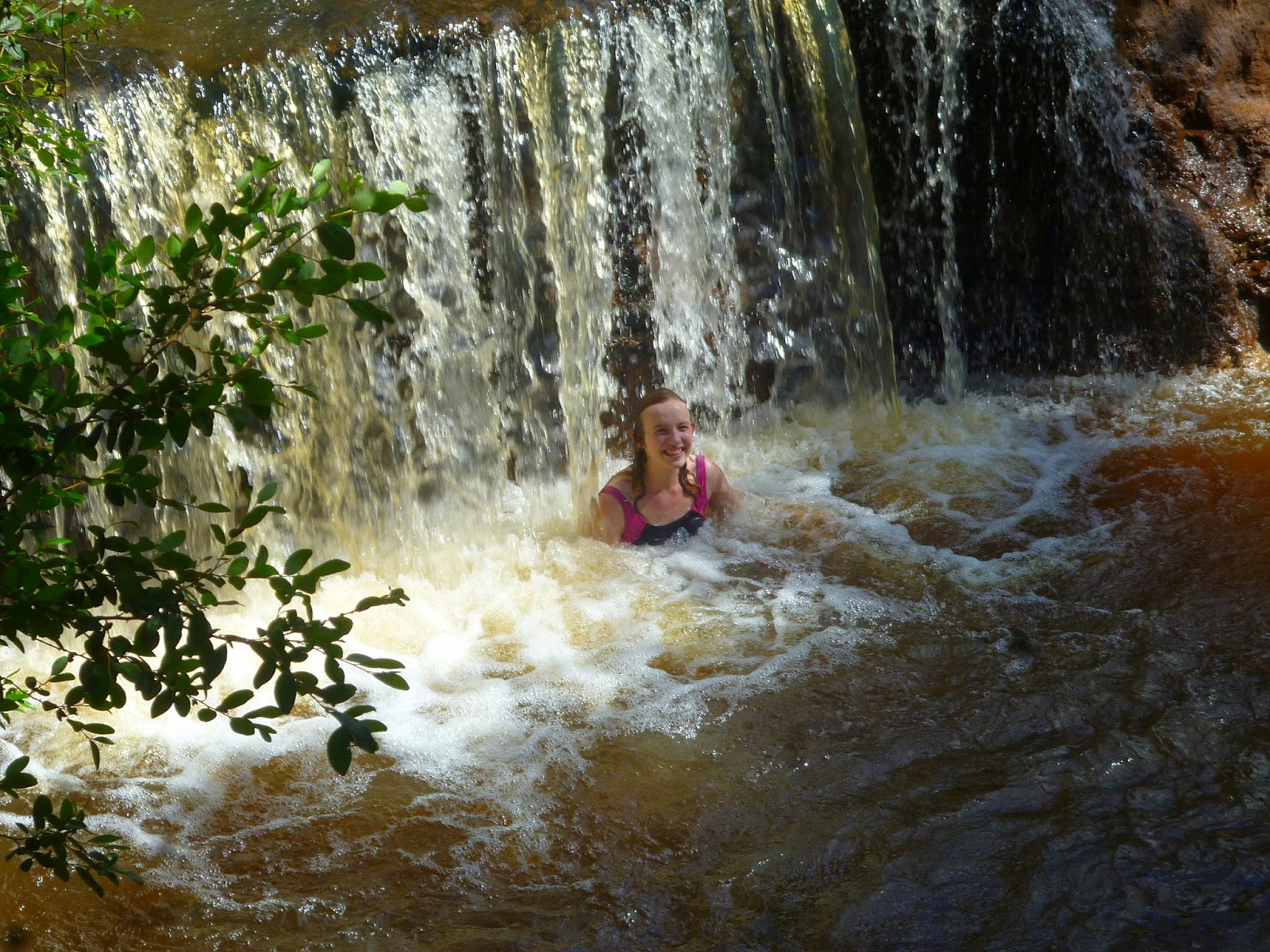
Yesterday was even hotter than usual, so we made the longer trip to the Chorro – half an hour on the motorbike along the dusty red road and then a grassy track. This was the destination:


 Quite idyllic!

Saturday, 14 February 2015

And we're off again... my home in Paraguay

I arrived safely in Paraguay on Friday 6th February, and in Santa Maria, Misiones - my home for the next six months - on Sunday.

I am staying with Demetria, a mother of five grown-up children who no longer live with her, and her chickens, ducks, three dogs, cat and budgie. The dogs and Mimi the cat all come and prostrate themselves at my feet at mealtimes or whenever they have the least suspicion that I might have something to eat. I never give in, but hope springs eternal. Demetria is very kind and laid-back with an excellent sense of humour - we laugh a lot.

Demetria and the house

My room
The kitchen
Out the back, with dogs and duck.